
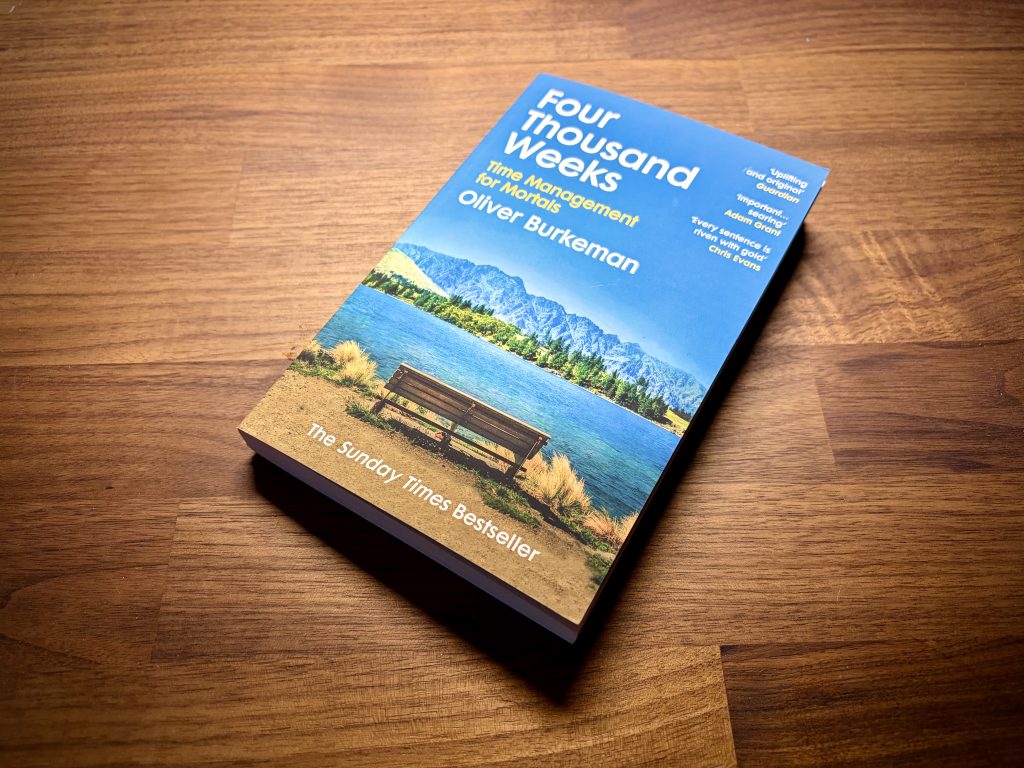

A couple of months ago, I finished reading Four Thousand Weeks by Oliver Burkeman. It was originally published in 2022 so it’s taken me a while to get round to reading it. I actually read his second book ‘Meditations for Mortals’ first, but I’ll save that review for another post.
I first heard of this book whilst attending a work training session. The speaker recommended reading this book saying “if you ever feel like you can’t wait for the week to be over, read this book. 4000 weeks doesn’t feel like much time.”
And that, in the shortest possible way, is the premise of the book. It’s about our relationship with time. It explores numerous ways in which we feel pressured, how there never seems to be enough time, and what’s truly important as we navigate through our brief flicker of life along the timeline of mankind.
What I like about Burkeman’s books is that there isn’t an attempt to game the system or find life hacks or establish another new set of routines. It’s about acceptance. Things are, the way they are. The future cannot be controlled, and this is both liberating and a source of friction given the way many people think.
From the very first chapter, it’s apparent that this is a very well researched book. By the author’s own admission, they’ve written this book for themselves as much as for the rest of us. Burkeman takes us through numerous stories, writing, and philosophies in an accessible narrative style. Without giving away any spoilers, each chapter carefully curates a different argument for our relationship with time and tasks, before moving gently onto the fringes of existentialism. Despite this, the book remains upbeat, and for me, I found Burkeman’s ideas highly relatable to my own outlook on life.
What resonated in particular for me was the idea that you can only ever steer the future, you can’t control it. There’s something strangely calming about that. We live in a culture obsessed with optimisation — five year plans, ten year plans, passive income strategies, life dashboards. And yet, when you zoom out, so much of life is shaped by randomness, luck, other people, or events completely outside of our control.
Burkeman doesn’t say “stop planning.” He says stop pretending you’re in charge of everything.
That distinction matters.
As someone who constantly feels the pull to be productive — to build something, launch something, refine something — the idea that I won’t “get to everything” is uncomfortable. But the book reframes that discomfort. The problem isn’t that I won’t do everything. The problem is believing I ever could.
You are finite. I am finite. Four thousand weeks if we’re lucky.
And once you accept that, something shifts. You stop asking, “How do I fit it all in?” and start asking, “What actually deserves to be here?”
That’s a very different question.
I actually think the best way to read this book is one chapter a day.
Not because it’s difficult, but because it needs space.
This isn’t a book you binge in an afternoon like a thriller. It’s a book that quietly rearranges your assumptions about time. If you rush it, you’ll turn it into another task — another thing to complete efficiently — which is ironically the exact mindset the book is gently dismantling.
Each chapter works almost like a meditation. It presents an idea, challenges a deeply embedded belief, and then leaves you with a slight cognitive wobble.
And that wobble is the point.
You need time to sit with it. To notice your own resistance. To observe how often you still default to “once I’ve sorted X, then I can relax.”
Because there is always another X.
There are moments in this book that hit hard. Given the sheer number of people who have ever existed, it is unlikely that any of us will leave a dent in the universe. Even with the greatest artists, thinkers, and leaders from the last 500 years: how many of them will actually be known in a thousand years time?
There are also moments where you are encouraged to accept you will fail at things in life. That the work is never done. Nothing is ever finished. There is no perfect. For someone like me who enjoys the idea of completing things, and wanting to succeed at a major level, this is quite difficult to accept.
But at the same time, my ambitious nature has led me to not living in the present. So, whilst it is difficult, these words have value.
The truth, then, is that spending at least some of your leisure time wastefully, focused solely on the pleasure of the experience, is the only way not to waste it – to be truly at leisure, rather than covertly engaged in future-focused self-improvement. In order to most fully inhabit the only life you ever get, you have to refrain from using every spare hour for personal growth. From this perspective, idleness isn’t merely forgivable; it’s practically an obligation.
– Oliver Burkeman
If you’re someone looking for actionable things from a book, this is perhaps not for you. It’s more thought-provoking, and encourages gentle reflection on your own attitudes to time. I feel like this book is more effective when combined with journaling, or in my case, having a conversation with ChatGPT after reading each chapter in order to help find deeper meaning from the text.
At the end of the book, there is an Appendix which essentially breaks down key lessons from the book, referencing chapter and page numbers, which is very helpful in recapping what you’ve learned from it. More books should do this.
The book doesn’t give you more time.
It takes the illusion of more time away.
And oddly, that feels like a gift.

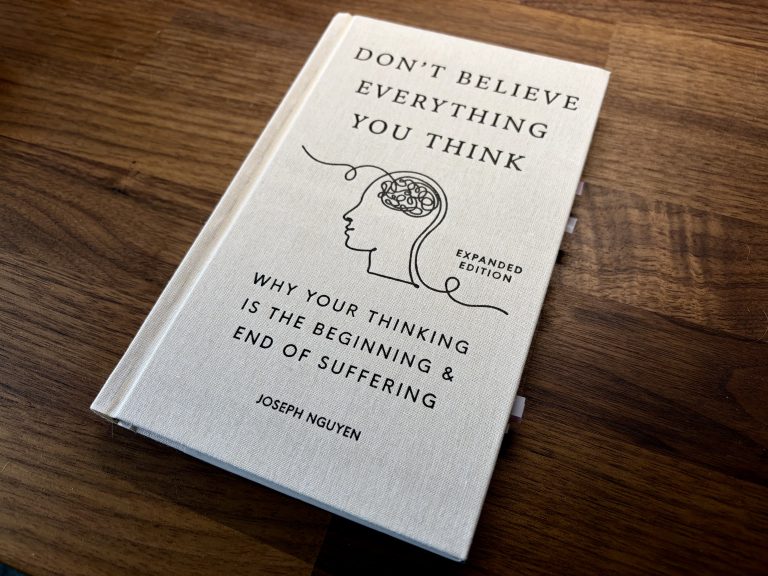

[…] reading 4000 Weeks, I started to realise […]