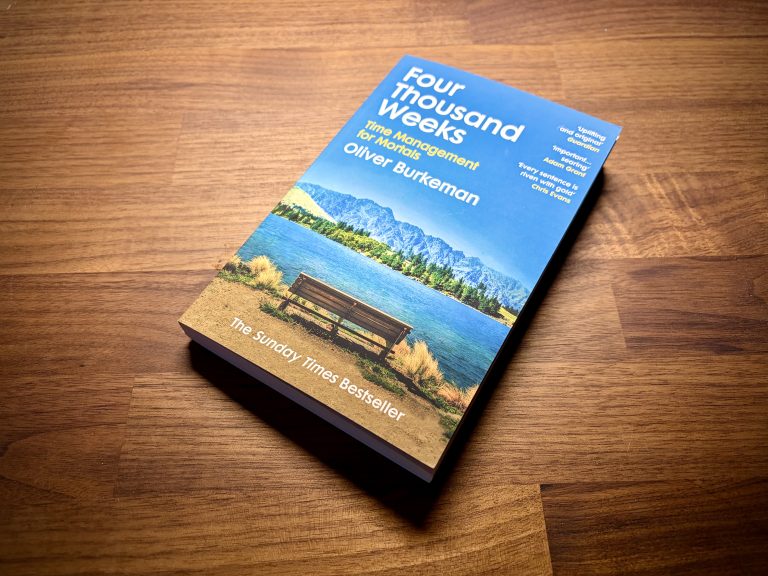

After reading 4000 Weeks, I started to realise something.
The problem wasn’t time. It was what I was doing with it.
Or more specifically… what I was thinking while I had it.
What if the issue isn’t about having enough time, but what occupies our minds when time finally becomes available?
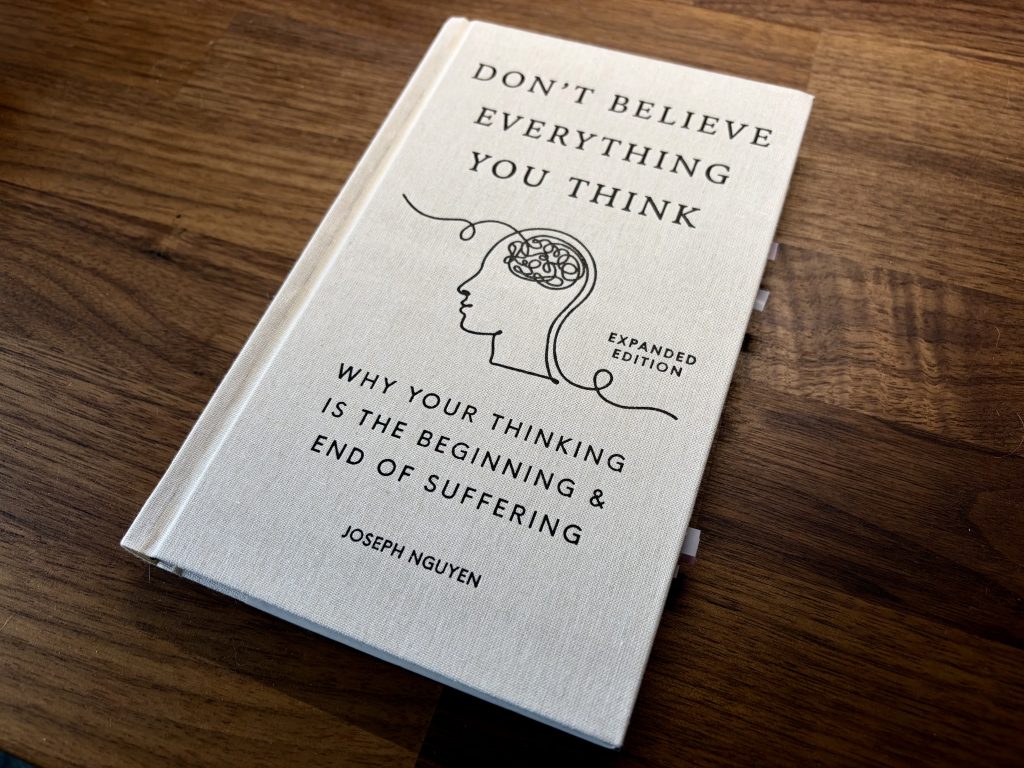
A few weeks ago, I came across Don’t Believe Everything You Think by Joseph Nguyen. It wasn’t on my reading list. I simply liked the cover, the blurb on the back, and the fact that it seemed to align with the line of thought I’ve been travelling down recently.
Based on the title alone, it would be easy to assume the book is about distrusting your judgement — or worse, trying to stop thinking entirely. But that isn’t really the premise. Very early on, the book introduces a distinction that sounds simple… but really isn’t: The difference between thoughts and thinking.
Thoughts simply appear. Thinking is what we do with them.
According to the book, most unnecessary suffering comes from that second part. At first, this sounds almost too simple to take seriously. But the more I sat with it, the more complicated it became. You can’t force yourself to stop thinking because the act of trying to stop thinking is itself another layer of thinking. Instead, it becomes more about awareness. Noticing when thinking is happening. And noticing what we do once it starts.
Unlike some of the other books I’ve read recently, this one isn’t particularly research-heavy. Instead, it relies heavily on analogy and ideas rooted in Zen Buddhist philosophy. One analogy in particular stayed with me throughout the entire book: the idea of two arrows.
The first arrow is the thing that happens to you.
The second arrow is everything you add on top of it.
Something unpleasant happens — that’s the first arrow. We often have little control over that.
But the second arrow? That’s the story we build around it.
The analysis. The rumination. The mental replaying. The attempts to solve, interpret, justify, or escape it. And according to the book, that second arrow is where much of our suffering actually lives.
You do not have to “try” to be present or “think positively” to experience love, joy, bliss, or any other positive emotions because those emotions are our natural state when we are not thinking. More times than not, the solution to our problems is not the addition of action but the removal of what’s causing those problems in the first place.
When I think about where a lot of my own mental energy disappears to, it’s usually there — in the second arrow. Over-analysing my day. Trying to extract meaning from hobbies and leisure. Questioning whether I’m spending my time “correctly”. Even during spare time, there can be this constant underlying tension, as though my brain is still trying to optimise or evaluate the moment while I’m inside it.
The book also talks about flow state — those moments where you become fully absorbed in something. You’re not analysing whether you’re enjoying it. You’re not questioning whether it’s productive. You’re just… in it.
For me, activities like video editing and writing music can sometimes create that feeling. When I’m fully engaged in them, the background noise fades away. Not because I’ve solved anything. But because I’m no longer feeding the noise with additional thinking.
That idea stayed with me.
There were parts of the book that resonated with me less. I’m generally cautious of overly systemised approaches to self-improvement, and the book occasionally leans in that direction — particularly with its introduction of the “PAUSE” framework. I understand why structures like that help some people, but interestingly, it was the less structured parts of the book that lingered with me most afterwards.
In terms of readability, the book is extremely accessible. It’s made up of short chapters, with recap sections that reinforce the key ideas. Much like 4000 Weeks, I think this is probably a book best read slowly — perhaps a chapter a day — allowing the ideas to sit with you rather than rushing through them.
Because the book isn’t dense with research or academic theory, it doesn’t demand much interpretation from the reader. Many books in this genre rely on vague metaphors or complicated systems that require you to “join the dots” yourself. Here, the writing is direct and intentionally simple, which makes philosophical ideas feel much more approachable.
Overall, I’m glad I came across this book.
It feels like it arrived at the right point in a broader philosophical journey I’ve been on recently — one centred around the possibility that discomfort often isn’t caused by life itself, but by our relationship with thinking.
For me, it helped explain why relaxation can sometimes feel strangely difficult. Why leisure can become something to analyse. Why there’s typically a layer of mental tension running quietly in the background. What I’ve taken from the book isn’t that thinking is bad. Or that we should somehow try to stop thoughts from appearing.
It’s more that unnecessary suffering may come from constantly following every thought that arrives. And maybe the answer isn’t to force that process to stop.
Perhaps it’s simply to notice when it’s happening… and choose not to follow it quite so far.